Change is constant in every growing organization. Constantly evolving with the times helps valuable growth take place, but growth also makes change harder to monitor. A change management strategy gives that work a structure so people understand what is changing, why it matters, how it affects them, and what they need to do next.
The hard part is not announcing a change. The hard part is helping people adopt it without cutting corners, losing accountability, or returning to the previous routine. A strong organizational change management strategy combines a clear model, visible ownership, communication, training, feedback, and repeatable processes so the change becomes normal work instead of a short-lived project.
In this article, we will look at eight change management strategies and models, then turn them into practical steps you can use to plan, communicate, and sustain effective organizational change.
What change management methods are we looking at?
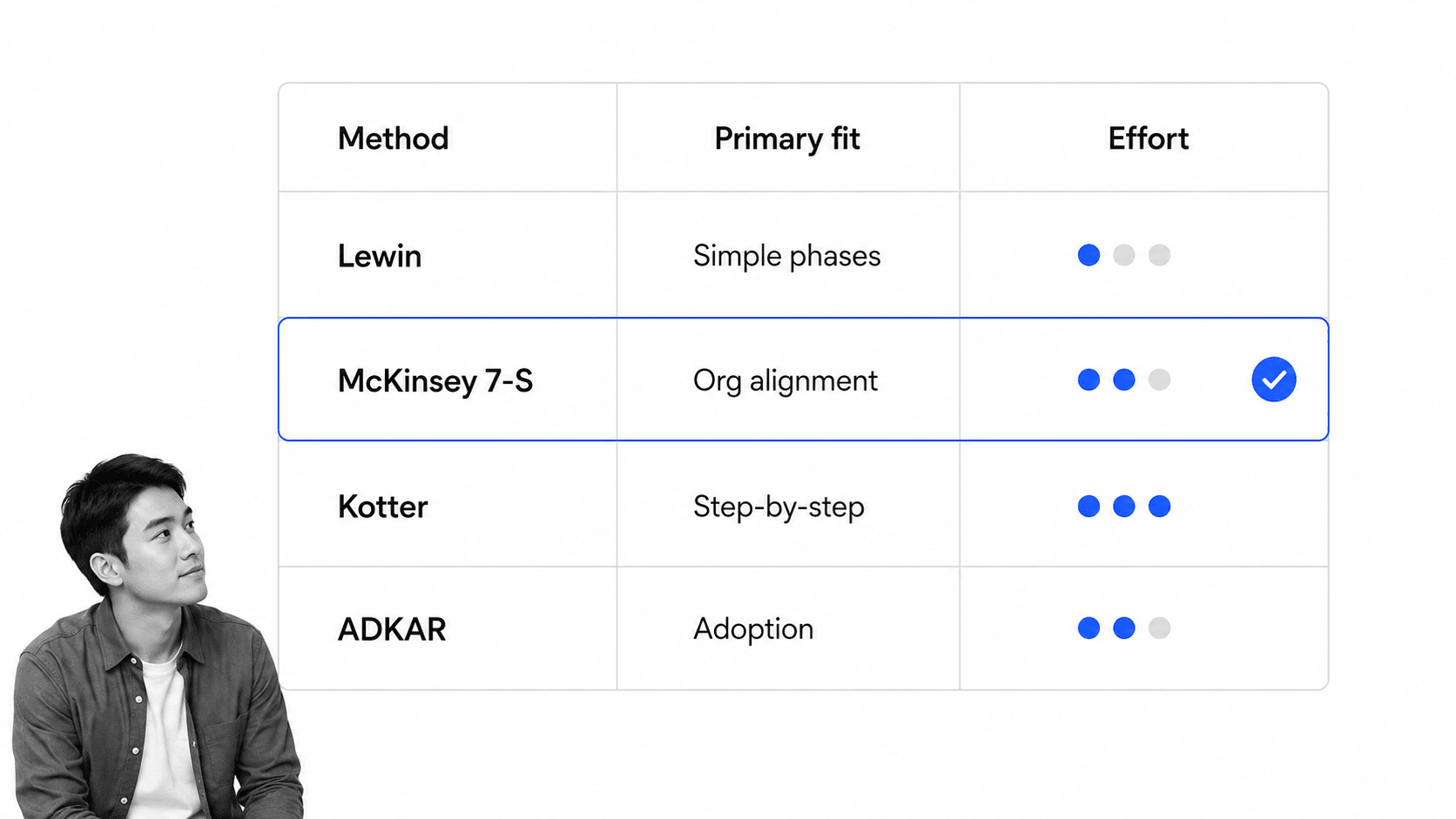
There is no single best change management model for every organization. The right choice depends on the size of the change, the number of stakeholders affected, how much behavior has to shift, and how much uncertainty the team is facing.
Some models are useful for simplifying a complex transformation into phases. Others are stronger for diagnosing organizational alignment, creating urgency, or supporting individual adoption. Most real change programs combine ideas from more than one model.
Change management models are useful because they give you a skeleton for what you might do to implement change in your business. Instead of inventing every step from scratch, you can use a proven model to think through the technical and human side of the transition.
These are the eight change management strategies covered below:
- Lewin’s change management model
- The McKinsey 7-S model
- Kotter’s theory
- Nudge theory
- The ADKAR model
- Bridges’ transition model
- The Kubler-Ross change curve
- The Satir change management model
1. Lewin’s change management model
Kurt Lewin’s model breaks organizational change into three phases: unfreeze, change, and refreeze. It is simple, but that simplicity is useful when teams need a shared language for moving from the current state to a new way of working.
The unfreeze stage prepares the organization. Leaders explain why the current process is no longer good enough, identify resistance, and create readiness. The change stage is where the new process, tool, policy, or behavior is introduced. The refreeze stage turns the new way of working into the standard through reinforcement, documentation, measurement, and leadership follow-through.
This model is strongest when a serious overhaul to one of your systems, processes, or core pieces of technology is required. It helps you dig up what could be affected before the change lands across the company.
Lewin’s model works well when a change has a clear before and after. It is less effective for continuous transformation, where the organization may not have time to fully refreeze before the next change begins.
You can also use a dedicated change management plan template to turn the model into assigned work.
2. The McKinsey 7-S model
The McKinsey 7-S model looks at seven elements of an organization: strategy, structure, systems, shared values, style, staff, and skills. The model is useful because it treats change as an alignment problem, not only a communications problem.
A new process might fail because the systems do not support it. A new strategy might fail because incentives still reward the old behavior. A new operating model might fail because teams do not have the skills required to make it work.
Use the 7-S model when the change cuts across functions or touches multiple parts of the business. It helps leaders ask whether the organization is actually set up to support the desired change, especially when employees have to adopt a new way of working.
3. Kotter’s theory
John Kotter’s approach is built around momentum. His model includes creating urgency, building a guiding coalition, forming a strategic vision, enlisting volunteers, removing barriers, generating short-term wins, sustaining acceleration, and anchoring the change in culture.
Kotter’s model is especially useful for large organizational change, where people need to see visible leadership commitment and repeated evidence that the change is moving forward. Short-term wins matter because they make progress concrete and give hesitant stakeholders a reason to keep participating.
In essence, the model asks leaders to meet with key figures affected by the change, create a sense of urgency by explaining why it is important, and then keep up enthusiasm with short-term goals and a steady drip feed of positive feedback.
The risk with Kotter’s model is treating it as a launch campaign rather than an operating discipline. Urgency and vision are not enough unless the work is backed by owners, timelines, training, and process controls.
4. Nudge theory
Nudge theory focuses on shaping choices rather than forcing behavior. Instead of relying only on mandates, teams design the environment so the desired action is easier, clearer, or more natural than the old habit.
For example, a team rolling out a new approval process can make the correct workflow the default, add contextual prompts at the decision point, simplify the form fields, and remove outdated paths that create confusion. These nudges reduce friction without making people feel trapped.
Nudge theory works best for behavior changes that happen repeatedly, such as following a checklist, submitting evidence, choosing a compliant approval path, or using a new internal tool. It can feel vague if used alone, but it is valuable when employees need an active role in changing the business for the better.
5. The ADKAR model
ADKAR stands for awareness, desire, knowledge, ability, and reinforcement. It is useful because it focuses on the individual journey through change, almost like a questionnaire for assessing whether a change has been understood, accepted, and enacted.
People need awareness of why the change is happening. They need desire to participate. They need knowledge of what to do. They need ability to perform the new behavior in real conditions. They need reinforcement so the new behavior lasts.
If a change stalls, ADKAR helps diagnose the gap. A training problem is different from a motivation problem. A motivation problem is different from a lack of leadership reinforcement. Treating those gaps differently is one of the main reasons ADKAR remains practical.
6. Bridges’ transition model
William Bridges’ transition model separates external change from internal transition. The change is the new system, structure, process, or policy. The transition is the psychological adjustment people go through as they let go of the old way and learn the new one.
The model has three stages: ending, losing, and letting go; the neutral zone; and the new beginning. This is valuable because organizations often move faster on the operational change than people can move emotionally.
Use Bridges’ model when a change affects identity, relationships, autonomy, or long-standing routines. It reminds leaders to give people space to understand what is ending before expecting full commitment to what is beginning, and it gives managers a foundation for guiding employees through the emotions that accompany the change.
7. The Kubler-Ross change curve
The Kubler-Ross change curve is often used to describe emotional reactions to change. In organizations, it can help leaders anticipate reactions such as shock, denial, frustration, experimentation, decision, and integration.
The model should not be used to label employees or assume everyone moves through the same stages at the same pace. Its value is in reminding leaders that emotional response is part of change management, especially when the change affects job security, team identity, or established expertise.
When used carefully, the change curve helps managers plan better communications, check-ins, and support for teams moving through uncertainty. It can also help leaders estimate the impact of a change on productivity so they are not taken off guard by a temporary setback.
8. The Satir change management model
The Satir model describes how performance can dip during change before improving. It starts with the late status quo, then moves through resistance, chaos, integration, and a new status quo.
This model is useful because it normalizes the temporary disruption that often follows a meaningful change. Teams may slow down while learning a new process. Error rates may rise before they fall. Confidence may drop before new habits form.
Satir is less of a how-to and more of an example of what progress might look like after a change. It helps predict how long productivity may be lower and why the resulting transformation can still lead to a new height of performance.
The key is to avoid mistaking the disruption for failure. If leaders provide support, feedback, and clear standards, the organization can move through the messy middle and reach a stronger operating state.
What is change management?
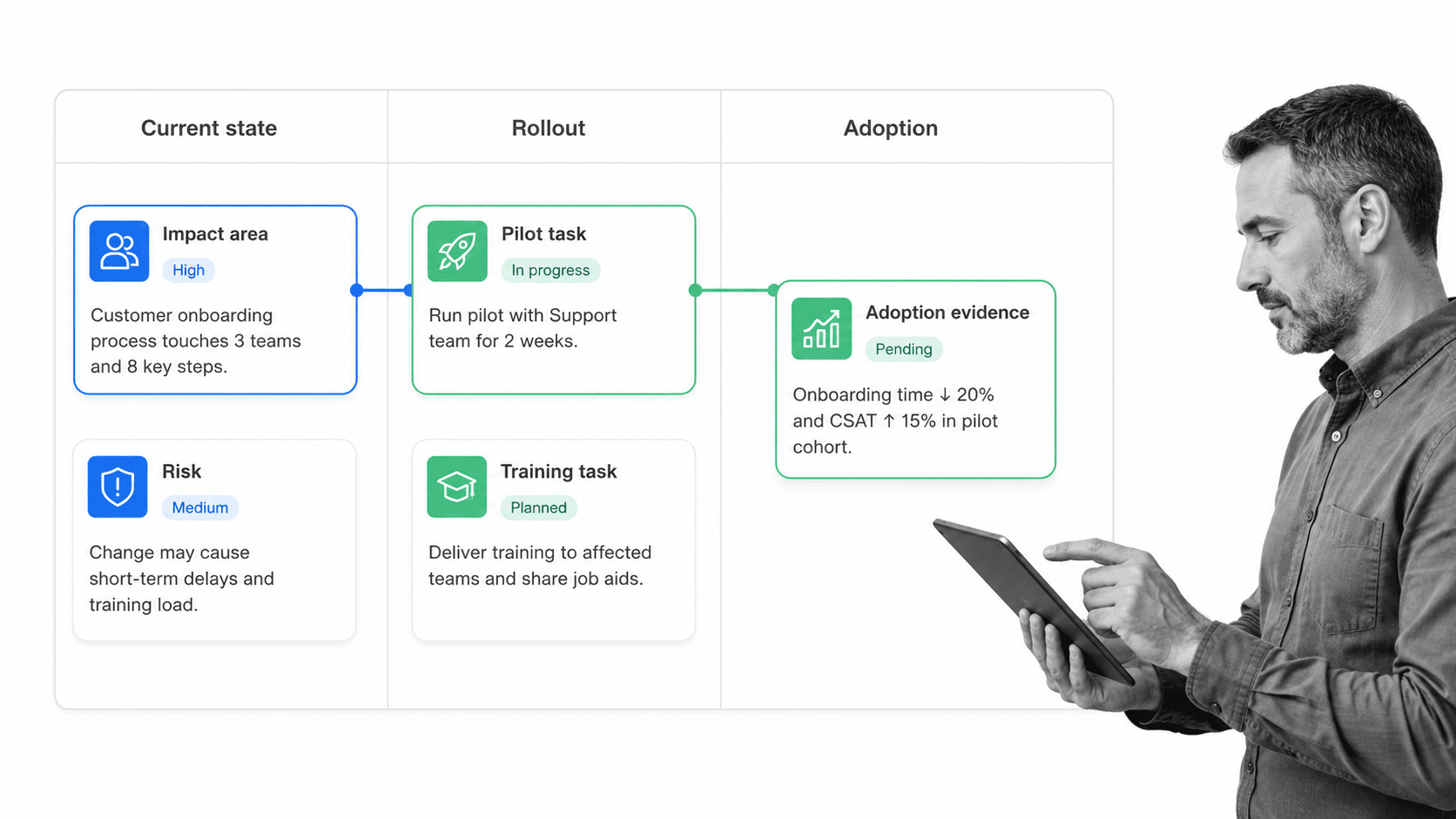
Change management is the structured approach an organization uses to move people, processes, systems, and behaviors from a current state to a desired future state.
That definition matters because successful change is not just a project plan. It includes the human side of adoption, the operational side of execution, and the governance needed to prove that the change has taken hold. The work often involves a dedicated change management team that analyzes software changes, process updates, new projects, and other events before coordinating with the technical and human side of the company.
A good change management process usually includes:
- A clear reason for the change
- A defined future state
- Stakeholder and impact analysis
- Executive sponsorship
- Communication and training plans
- Assigned owners for rollout tasks
- Feedback channels
- Adoption metrics and reinforcement
Without those elements, change tends to depend on individual memory and informal follow-up. That might work for a small team, but it breaks down quickly when the change touches multiple departments, locations, or compliance requirements.
When change management is done well, the human elements of the company can adapt to the changes that affect them. It also creates feedback opportunities that show employees their voices are being heard, which matters for morale, job satisfaction, and adoption.
Don’t underestimate the importance of a change management strategy
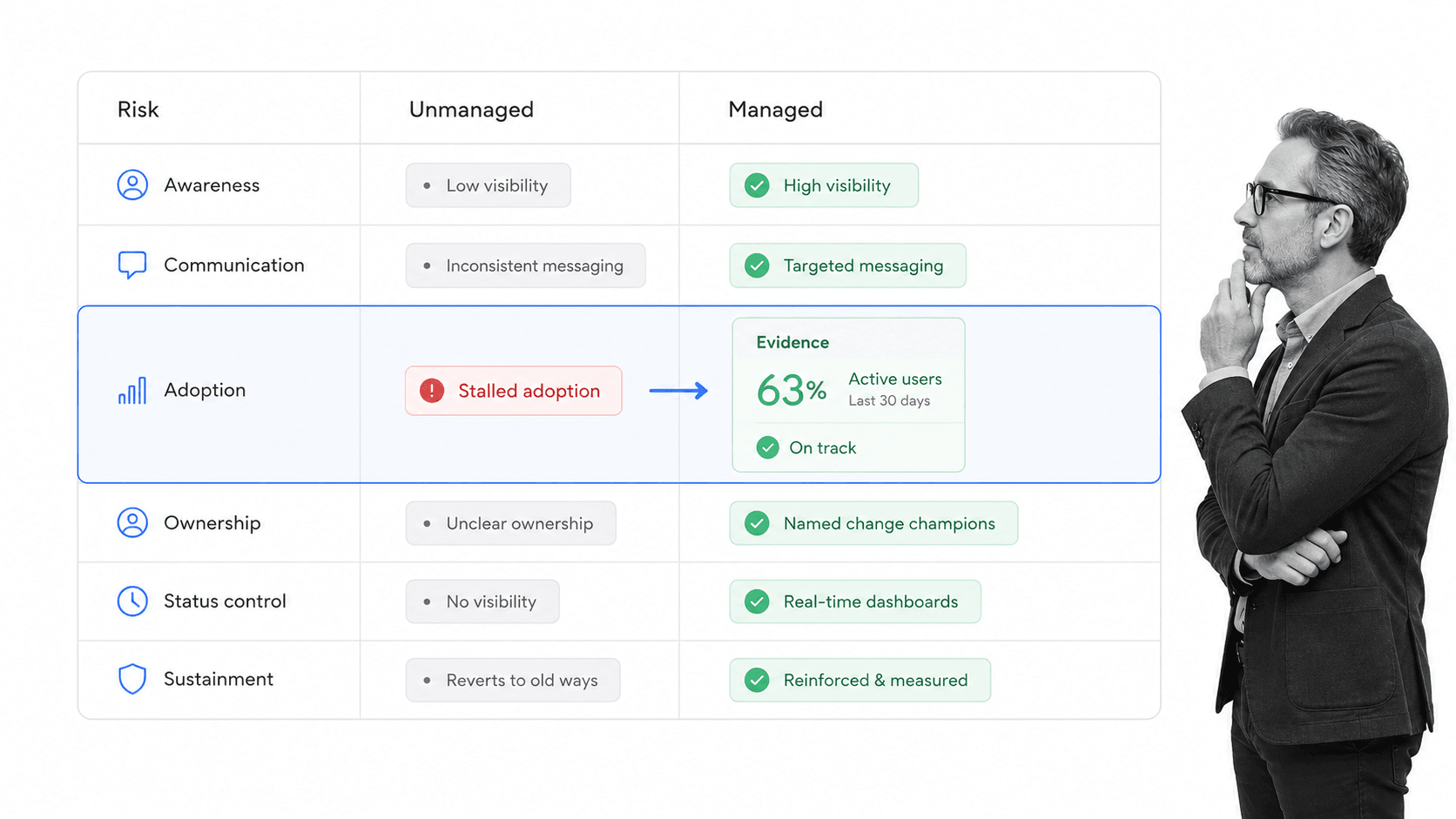
A change management strategy explains how the organization will guide people through change and make adoption stick. It turns a broad decision into a sequence of actions, owners, evidence, and feedback loops.
Companies need to be constantly changing and improving, whether that means reviewing processes, training employees further, expanding a network, updating technology, taking on new projects, or doing something else. A company that does not change and evolve is standing still, and a company standing still is slowly falling behind competitors.
Without that strategy, leaders often rely on a launch meeting, a few emails, and the assumption that people will adjust. That is where change programs lose momentum. People return to familiar habits, managers interpret the change differently, and teams invent their own workarounds.
A strong strategy reduces those risks by making the change visible and measurable. It clarifies who owns the work, what decisions have already been made, which stakeholders are affected, what training is required, and how adoption will be measured after rollout.
It also helps with resistance. Resistance is not always stubbornness. Sometimes people resist because the change is unclear, the benefits are vague, the process conflicts with another priority, or the new behavior creates more work than leaders realize. A good strategy creates room to surface those issues before they become blockers.
For regulated or process-heavy teams, strategy also protects accountability. If a change affects approvals, evidence, policies, customer delivery, employee onboarding, vendor management, or security controls, leaders need more than verbal confirmation. They need a reliable record of what changed, who approved it, and whether teams are following the new process.
That is why employee adoption matters as much as the initial decision. Encouraging change is not enough if teams do not understand the benefits, cannot see how the work should be handled, or have no consistent way to track progress.
Tips for creating the best change management strategy
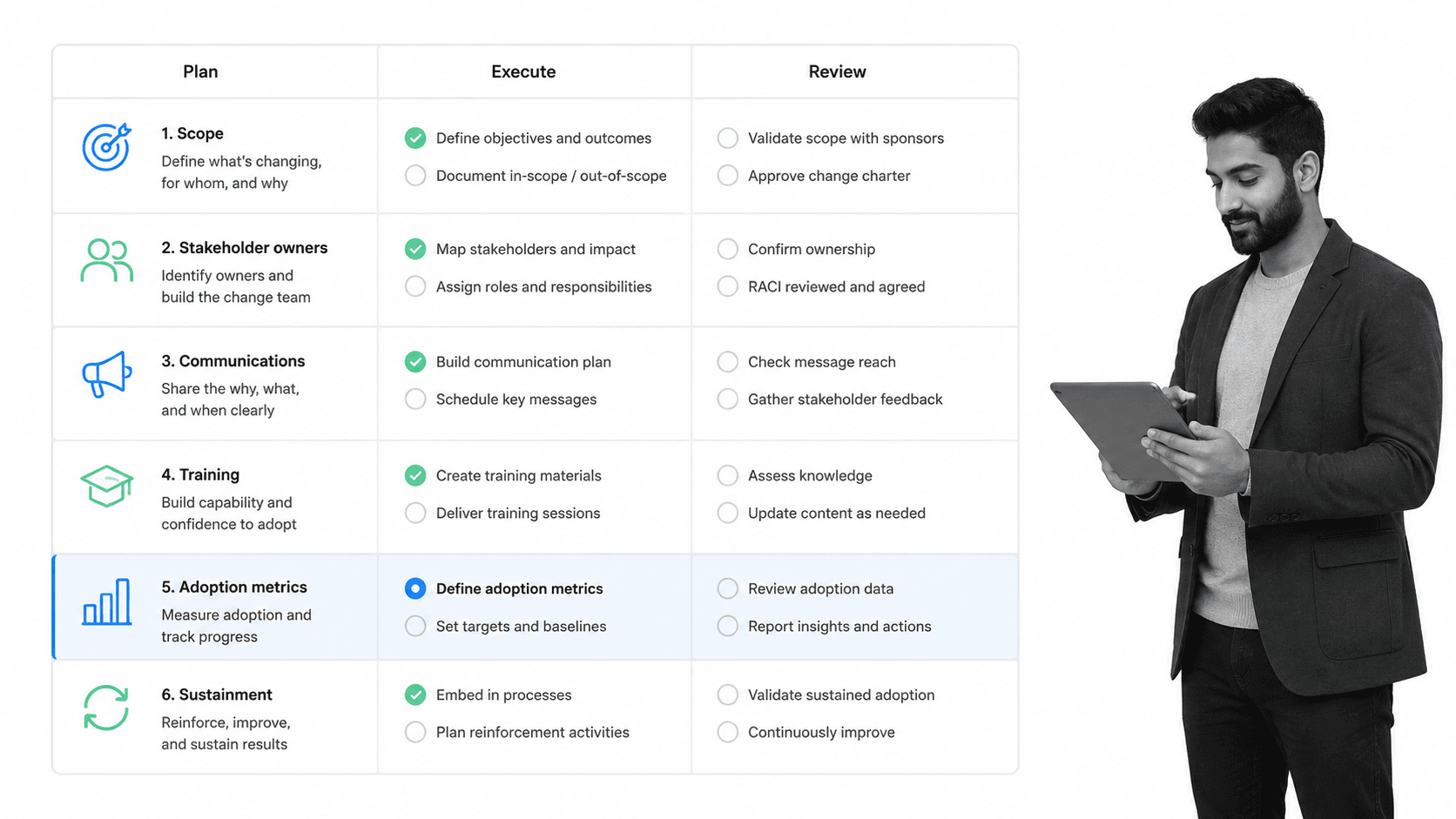
Change management models are useful, but the strategy has to work in the daily operating rhythm of the business. These practical tips help turn the theory into work people can actually follow.
Define the change
Start by defining the change you are managing. Change management exists to help changes be consistently and successfully applied across an entire company, which is impossible if the change itself is vague.
It is not enough to give broad benefits or descriptions. Lay out what the change will be, how it will be achieved, how it will be tracked or measured, and which success metrics it should affect. The definition should be clear enough for anyone in the company to read, understand, and take action on.
Use a current source of truth for this definition. Process Street Docs can keep the change description alongside related policies and business processes, so everyone works from the same information instead of scattered updates.
Keep it simple
If you do not keep your changes simple, nobody will want to take action on them. People need language they can understand quickly and a benefit they can see without decoding a strategy document.
If the change cannot be described easily, the scope may be too broad. Break the change into smaller chunks that can be enacted over time. That reduces the risk of alienating employees or team members by ripping up an entire routine at once.
Map stakeholders and impact
List every group affected by the change. Include the people who approve it, the people who execute it, the people who are measured by it, and the people who depend on its results.
Then map how each group is affected. Some stakeholders need awareness only. Others need training, new responsibilities, new tools, or support from managers. Impact mapping keeps the strategy from treating every audience the same.
Start at the top
Before you try to convince front-line employees of the changes you want to make, upper staff and managers need to present a unified front. If leaders disagree on how the change should be done, each team may take a different approach and leave success to random chance.
People pay attention to what leaders reinforce. Executive sponsorship should be more than a name on a slide. Sponsors should explain the reason for the change, remove blockers, make tradeoffs, and keep managers aligned.
Make sure managers see eye-to-eye on what changes need to be made, how they should be done, what the ultimate goals should be, and how progress will be tracked. Without common factors to track, measuring success becomes next to impossible.
But don’t forget the front lines
Upper management and team leaders can coordinate change, but without listening to those on the front line, you leave room for error and dissent. Once team leaders are aligned, bring employees into the conversation as early as practical.
Depending on the size of the company, it might not be possible to meet every employee one-on-one or even in small groups. Even then, teams still need a reliable way to ask questions, voice concerns, and share feedback without waiting for a formal meeting.
Communicate the why, what, and when
Good communication answers three questions: why the change matters, what is changing, and when people need to act. Keep the message concrete and repeat it through channels the audience already uses.
Avoid a single launch announcement. Change communication should continue through rollout, adoption, and reinforcement. People need reminders, examples, and updates as they encounter the change in real work.
Use culture to your advantage
A large part of managing change is knowing your company culture, including its strengths and weaknesses. If you understand how people work, communicate, what they like and dislike, what they do well, and where they struggle, you can plan the best way to apply the change.
The goal is to make everything run smoothly rather than alienating the workforce with massive shifts in practice. What looks like a minor alteration from a leadership seat can become a major rift if it ignores how teams currently work and communicate.
Tie changes to strategic and emotional benefits
Employees need to understand both the strategic and emotional benefits of a change. It is not enough to say that a new program will help them work quicker or make their job easier in the long run. Connect the change to outcomes they are personally motivated to achieve.
For example, a change might give people more time for interesting work, help them complete projects in advance to avoid late-night edits, or let them branch out into more varied duties. Those benefits are not just operational. They speak to people with different interests, goals, and desires.
Train for behavior, not just awareness
Training should prepare people to do the new work, not merely understand the idea. If the change introduces a new workflow, give people practice in the workflow. If the change affects judgment, show examples and decision rules.
Training also needs a feedback path. If people cannot apply the new process after training, the problem may be the process design, not the training attendance rate.
Encourage behavior shifts, not just actions
Telling an employee to perform an action may get a task done once, but it will not stop them from returning to a previous routine when initial enthusiasm wears off. Showing how to perform the new action, why it matters, and what goal it supports is more likely to alter behavior.
This is where change management becomes more than a technical rollout. When people understand the thought process behind the new work, they can form habits that stick and produce high-quality work without being reminded every time.
Document the process
Documentation turns change into a repeatable standard. It should include the new process, roles, decision points, escalation paths, approvals, and evidence requirements.
For process-heavy work, connect the change plan to process documentation so teams can find the current source of truth. A clear process documentation system reduces ambiguity after launch.
Support your changes with a formal framework
Without a set framework to follow, it is difficult to consistently deploy and track changes across the organization. Documented processes give teams a repeatable set of instructions and a shared standard of quality.
Whether you are using an editing checklist, an approval workflow, or a company-wide template for deploying changes effectively, consistency is what makes measurement possible. You can only reliably improve what you can track.
Measure adoption
Adoption metrics should show whether the change is being used in practice. Examples include completion rates, cycle time, error rates, policy exceptions, approval delays, training completion, support tickets, and audit findings.
Choose a small set of meaningful measures. Too many metrics create noise. Too few metrics make it difficult to know whether the change is working.
Use feedback to improve the rollout
Feedback should be part of the strategy from the beginning. Create a simple way for teams to report friction, confusion, missing information, and unintended consequences.
Then act on the feedback. When people see that their input leads to improvements, resistance drops and the change becomes more collaborative.
Reinforce the new standard
Reinforcement is where many change programs fail. Leaders launch the change, teams comply for a while, and then old habits return.
Build reinforcement into the operating system. Update workflows, checklists, policies, dashboards, manager routines, and audit points. Make the new behavior easier to repeat than the old one.
Choose tools that support the change
Tools should support the strategy rather than become the strategy. The right change management tools help teams document the process, assign work, collect evidence, track status, and keep stakeholders aligned.
If a tool adds complexity without improving adoption, it will become another source of resistance. Choose technology that makes the new process easier to follow.
Become a change management master with Process Street
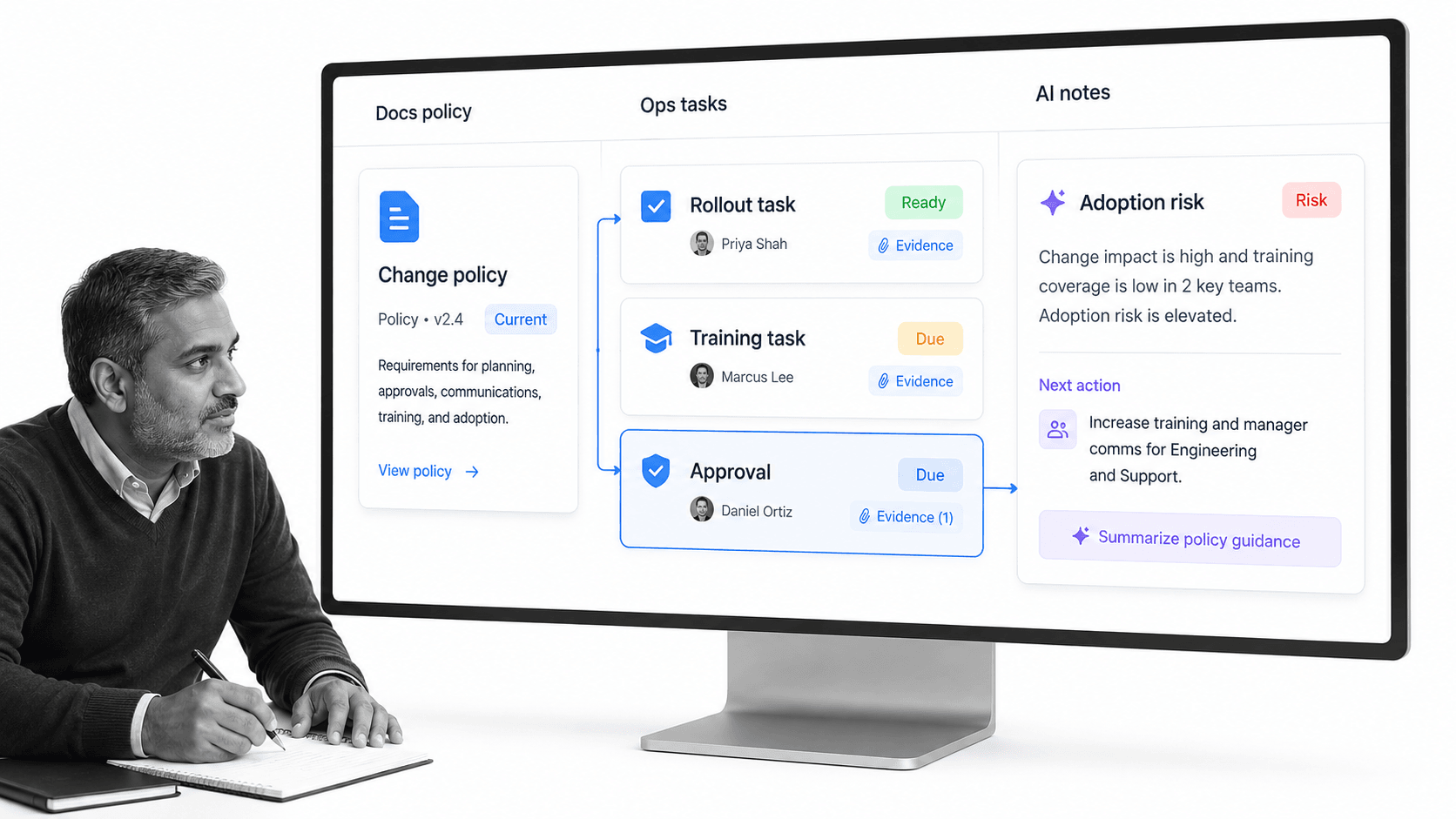
Process Street helps teams turn change management strategy into repeatable operational work. It brings documentation, assigned workflows, approvals, evidence, and automation into one Compliance Operations Platform.
Use Process Street Docs to keep policies, procedures, and change guidance in one current source of truth. Use Ops to run the actual rollout work with assigned tasks, due dates, conditional logic, approvals, forms, and evidence capture. Use built-in AI to summarize guidance, support task execution, and help teams spot risks in the workflow.
That matters because change management requires both clarity and follow-through. A policy sitting in a document library does not create adoption by itself. A task list without policy context can drift from the standard. Connecting Docs and Ops helps teams move from intention to execution.
Process Street can support change management work such as:
- Change request intake
- Stakeholder review
- Impact assessment
- Approval routing
- Communication planning
- Training rollout
- Evidence collection
- Adoption review
- Post-implementation process updates
For example, a team rolling out a new employee onboarding process can keep the onboarding policy in Docs, run each department’s rollout tasks in Ops, require manager approvals, collect completion evidence, and review adoption risks with AI support.
The same approach works for compliance changes, software rollouts, procurement updates, customer operations changes, and any process where people need to follow a new standard consistently.
Change management is easier when the process is visible, the owners are clear, and the evidence is captured as the work happens. That is what Process Street is built to support.